坤灵最新logo-scaled-1.png)
In laboratory planning and construction, engineers must carefully determine the dimensions of the Laboratory Work Bench, as this decision directly influences space utilization, operator efficiency, and long-term functional flexibility. Therefore, from an engineering perspective, this article systematically explains the key parameters and scientific principles that guide Laboratory Work Bench dimension design.
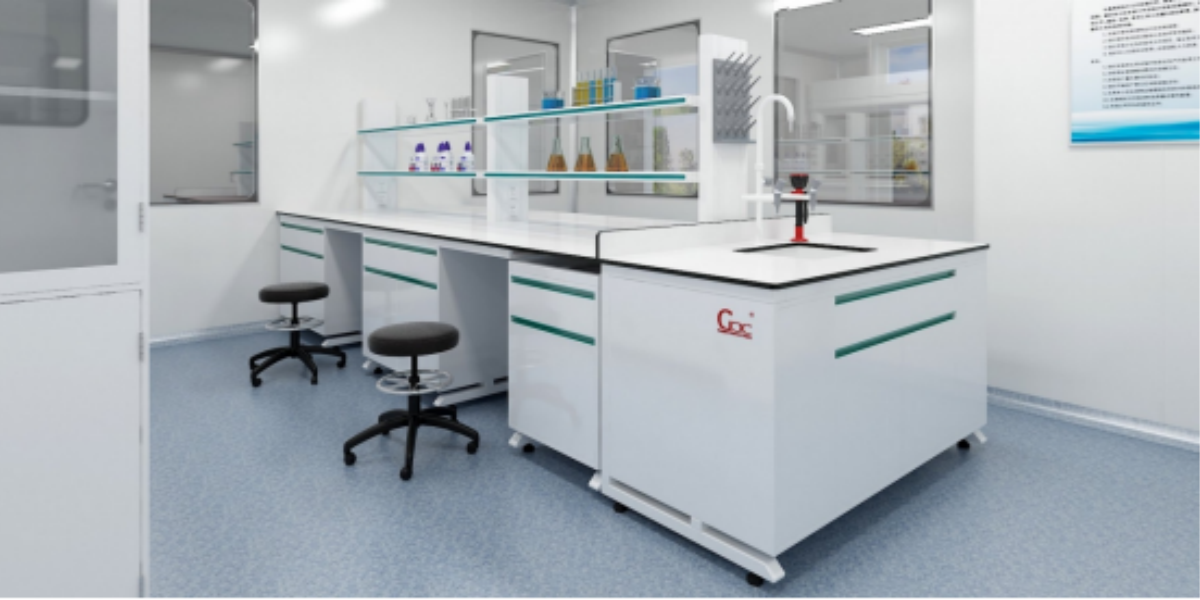
I. Core Determining Parameters: From Function to Space Analysis
The dimensions of a Laboratory Work Bench do not rely on a single fixed standard. Instead, designers must evaluate multiple engineering parameters together to achieve a safe, efficient, and practical solution.
1. Laboratory Type and Core Functions
First and foremost, the laboratory’s intended application determines the fundamental design direction. Because different disciplines impose different operational and equipment requirements, the Laboratory Work Bench must adapt accordingly.
- Chemical / Biological Laboratories
These laboratories require frequent hands-on experimental operations. As a result, the Laboratory Work Bench must provide sufficient depth and width to accommodate instruments such as spectrophotometers and centrifuges, as well as reagent racks and auxiliary devices. Moreover, the design must allow safe working zones when fume hoods or flexible exhaust arms operate nearby. - Physical / Electronic Laboratories
In contrast, these laboratories focus on assembly, testing, and measurement. Therefore, the Laboratory Work Bench design must prioritize precision instrument placement and structured cable management, in addition to basic working surfaces. - Analytical Testing Laboratories
These laboratories primarily house large analytical instruments such as HPLC or GC-MS systems. Consequently, engineers must base Laboratory Work Bench dimensions on equipment footprint, heat dissipation requirements, and maintenance access rather than on operator space alone.
2. Functional Positioning of the Laboratory Work Bench
After clarifying laboratory type, designers must define the functional role of the Laboratory Work Bench.
- Operation-Oriented Laboratory Work Bench
This type emphasizes operator comfort and accessibility. Therefore, engineers must size the bench depth and length to support multiple users working simultaneously while complying with ergonomic principles. - Equipment-Oriented Laboratory Work Bench
In this case, equipment performance governs design. Accordingly, engineers must calculate bench dimensions based on equipment weight, vibration characteristics, and service clearance, while reserving adequate space for ventilation and maintenance.
3. Number of Users and Ergonomic Considerations
To ensure safe and efficient operation, designers must apply ergonomic standards throughout the Laboratory Work Bench design process.
- Bench Depth
Common standard depths include 750 mm, 800 mm, 850 mm, and 900 mm. If the bench is too shallow, operators lack sufficient workspace. Conversely, excessive depth reduces reachability. Therefore, engineers often select 800 mm as a balanced and practical depth. - Bench Height
Standard bench heights typically range from 850 mm to 900 mm. However, engineers should adjust the final height according to the average user height. In addition, laboratories that require prolonged microscope work should adopt height-adjustable Laboratory Work Benches. - Operating Length per User
To prevent crowding and improve workflow, designers should allocate no less than 1.2 m to 1.5 m of longitudinal operating length per user.
4. Site Measurement and Spatial Layout
Because the Laboratory Work Bench forms the core of the laboratory layout, designers must accurately integrate it into the available space.
- Aisle Clearance
Engineers must maintain sufficient safety aisles between Laboratory Work Benches and wall benches or between adjacent benches. Specifically, main aisles should measure no less than 1500 mm, while secondary aisles should remain above 1200 mm. As a result, personnel movement, equipment transport, and emergency evacuation remain unobstructed. - Room Dimensions and Shape
Designers must base Laboratory Work Bench dimensions on net room measurements after deducting walls, columns, and fixed structures. Therefore, irregular room shapes usually require customized Laboratory Work Bench solutions rather than standard modules.
5. Load-Bearing Capacity and Structural Requirements
In addition to spatial considerations, structural performance plays a decisive role in dimension selection.
- Worktop Materials
Different materials—such as solid phenolic boards, epoxy resin tops, and stainless steel—exhibit different load capacities and allowable spans. Consequently, when engineers design long Laboratory Work Benches, they must calculate support spacing and add reinforcement to prevent long-term deformation. - Cabinet and Frame Structure
Steel-wood or all-steel cabinet systems provide primary structural support. Therefore, areas intended for heavy instruments must receive structural reinforcement during the design stage rather than after installation.
II. Dimension Determination Process and Engineering Implementation
To achieve reliable results, engineers should follow a structured design process.
- Requirement Analysis
First, engineers define the laboratory discipline, major equipment list, number of users, and core workflows. - Preliminary Layout Planning
Next, designers create a preliminary layout to determine the configuration of the Laboratory Work Bench—such as straight, L-shaped, or island type—and establish an initial dimension range. - Equipment and Utility Integration
Then, engineers accurately mark equipment footprints and coordinate utility interfaces for power, water, gas, and ventilation systems. - Detailed Design and Customization
When standard dimensions cannot meet project requirements, engineers develop customized Laboratory Work Bench solutions. For example, in high-standard PCR laboratory projects, Guangzhou Kunling Environment designs non-standard Laboratory Work Benches based on specific sequencing equipment models, ensuring seamless workflow integration. - Professional Review and Approval
Finally, laboratory users, management teams, and engineering specialists jointly review and confirm the final design.
Conclusion
In summary, determining Laboratory Work Bench dimensions requires a comprehensive engineering approach that integrates functionality, spatial planning, ergonomics, and structural performance. Although no single universal size standard exists, clear scientific and engineering principles guide the decision-making process. By following a systematic evaluation and design workflow, laboratories can achieve Laboratory Work Bench solutions that are safe, efficient, and adaptable to future needs.
Ready to optimize your Laboratory Work Bench for your lab? Call us now for a personalized consultation.