坤灵最新logo-scaled-1.png)
In laboratory engineering and planning, laboratory bench dimensions play a critical role in ensuring safety, operational efficiency, and ergonomic comfort. Proper dimensional design directly affects workflow efficiency, user comfort, and equipment compatibility. This article systematically explains the engineering standards for laboratory benches, covering length, width (depth), height, and functional zone allocation.
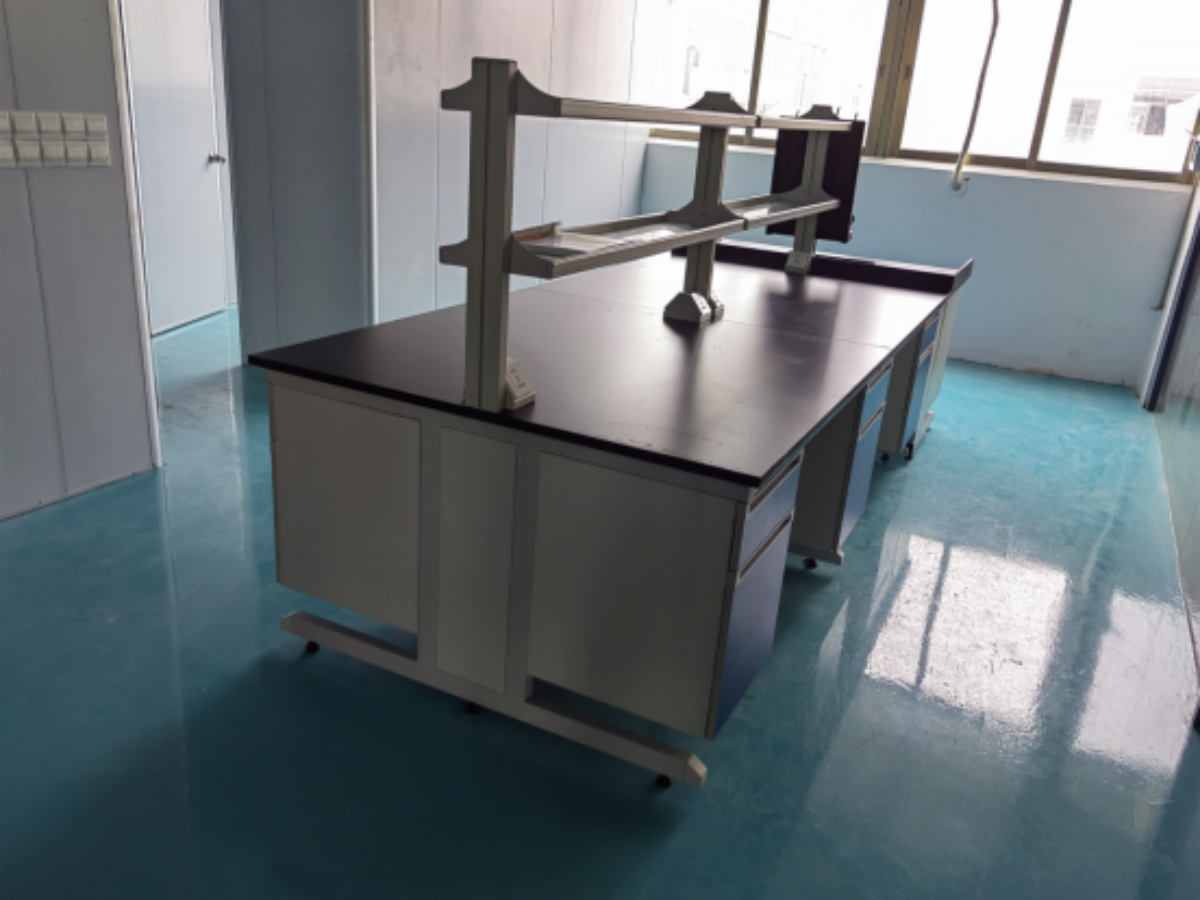
1. Length Standards for Laboratory Benches
The length of a laboratory bench mainly depends on available wall space and experimental workflow requirements.
1.1 Standard Modular Lengths
Industry-standard modular cabinet lengths typically include 900 mm, 1000 mm, 1200 mm, and 1500 mm. By combining these standard modules, designers can flexibly configure the required overall laboratory bench length.
1.2 Overall Length Planning Considerations
When planning the total bench length, designers should consider the following factors:
- Laboratory space dimensions: Accurately measure the net wall length at the installation location.
- Functional coordination: Reserve adequate spacing for fume hoods, emergency eyewash stations, power outlets, and other safety equipment.
- Future expansion: When space permits, allow room for future functional upgrades or extensions.
1.3 Customized Solutions
For non-standard or irregular laboratory layouts, fully customized solutions are recommended. For example, Guangzhou Kunling Environment provides integrated custom laboratory bench solutions based on precise laboratory floor plans, maximizing space utilization while maintaining engineering compliance.
2. Width (Depth) Design Standards for Laboratory Benches
Bench width is a key parameter that affects both operating space and aisle clearance.
2.1 Common Width Standards
- Standard width: The most commonly used laboratory bench width is 750 mm, offering a balance between working surface area, storage capacity, and smooth personnel movement.
- Compact width: In space-constrained areas, a 600 mm wide laboratory bench may be used, although this reduces available workspace and cabinet storage.
- Extended width: For areas requiring large instruments or complex operations, bench widths of 850 mm to 900 mm are recommended.
2.2 Relationship Between Bench Width and Aisle Clearance
Laboratory bench width must be coordinated with aisle dimensions. According to Research Building Design Standards, the minimum clear width of main aisles should not be less than 1.5 meters. When a laboratory bench is 750 mm wide, the clear aisle width between the bench and a central island or wall should also be at least 1.5 meters, allowing two people to pass comfortably.
3. Height Determination Principles for Laboratory Benches
Bench height directly affects operator comfort, efficiency, and long-term health.
3.1 Standard Height Range
In China, the standard height for laboratory benches generally ranges from 850 mm to 900 mm, which suits most standing laboratory operations.
3.2 Ergonomic and Adjustable Designs
To accommodate users of different heights and task requirements, adjustable-height laboratory bench systems are increasingly popular. When developing project solutions, Guangzhou Kunling Environment evaluates average user height and primary work activities to recommend fixed heights (850 mm or 900 mm) or electric height-adjustable bench systems.
3.3 Special Operation Heights
- For high-precision observation or writing tasks, raised laboratory bench areas of 1000–1100 mm may be applied.
- For zones housing large or heavy equipment, slightly lower bench heights can improve operational convenience and safety.
4. Functional Zoning Standards and Dimensional Integration
Laboratory bench dimensions directly support functional zone planning.
4.1 Operation Zone
This is the core functional area of the laboratory bench. Its size depends on both bench length and width, ensuring sufficient continuous and flat workspace for equipment placement and experimental operations.
4.2 Equipment Placement Zone
This zone accommodates commonly used medium-sized equipment such as centrifuges and shakers. Designers must consider heat dissipation and vibration control. The laboratory bench area should match equipment dimensions and reserve at least 50 mm of clearance for ventilation and safe operation.
4.3 Reagent Shelves and Storage Zones
- Over-bench reagent shelves: Typically installed at the rear of the worktop, with depths of 200–300 mm and heights of 400–600 mm, ensuring visibility and ease of access without obstructing operations.
- Under-bench cabinets: Cabinet dimensions closely relate to laboratory bench width and height. Standard base cabinets are usually 100 mm shallower than the benchtop (e.g., a 650 mm cabinet depth under a 750 mm benchtop) to provide adequate foot clearance.
4.4 Utility Routing Zones (Water, Power, Gas)
Laboratory bench width and cabinet design must reserve space for concealed routing of water, electrical, gas, and ventilation lines. Professional engineering services—such as those provided by Guangzhou Kunling Environment—integrate dedicated utility channels within cabinets and back panels to ensure safety, cleanliness, and ease of maintenance.
5. Conclusion
Laboratory bench dimensions are not isolated numbers but part of an integrated engineering system that balances space, personnel, equipment, and workflows. Strict adherence to standards for length, width, height, and functional zoning forms the foundation of a safe, efficient, and sustainable modern laboratory. During project planning, partnering with a supplier that possesses strong engineering design and implementation capabilities is essential to ensure these standards are accurately executed in real-world applications.