坤灵最新logo-scaled-1.png)
In pathology laboratories, staff rely on ventilation systems to remove hazardous gases and maintain a safe working environment. However, traditional ventilation systems often consume excessive energy and introduce safety risks. Smart fume hoods actively address these challenges, providing both safety and energy efficiency.
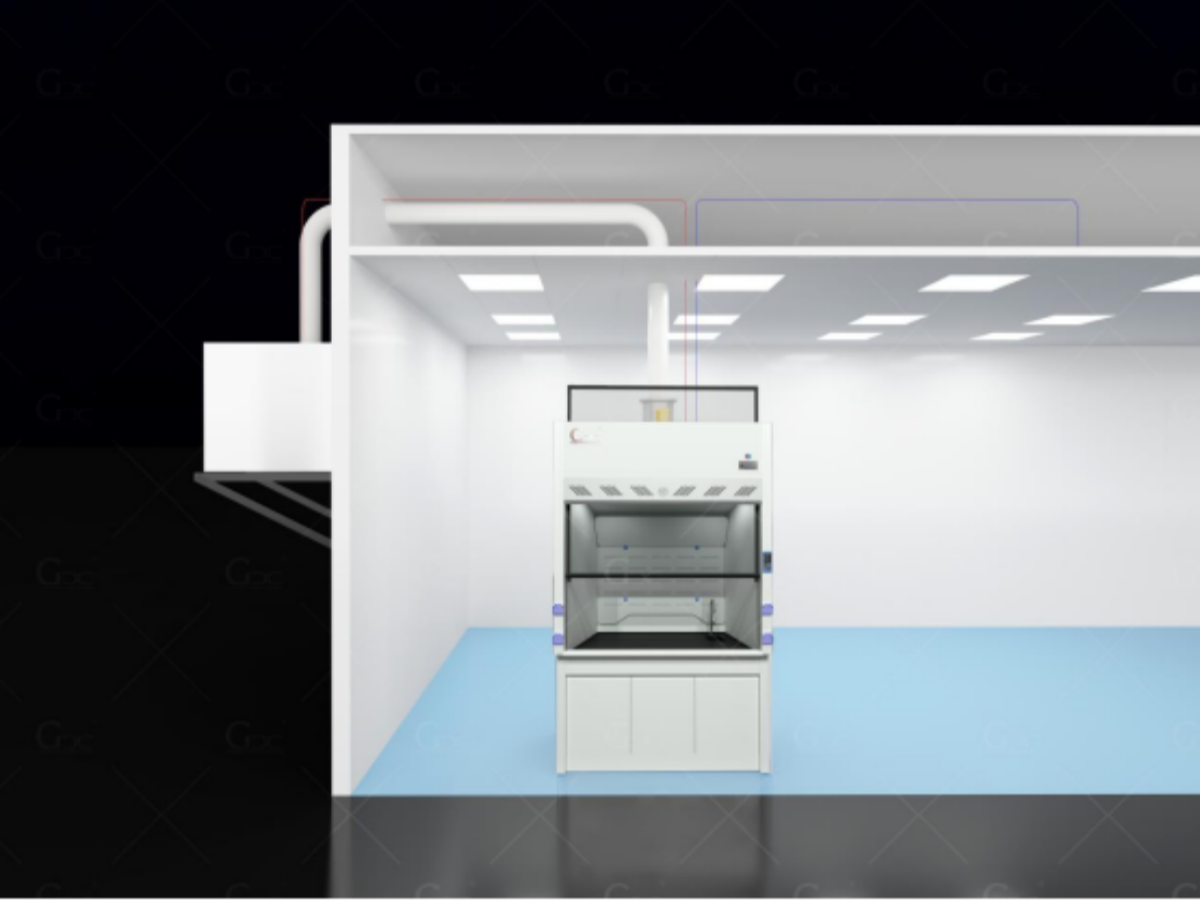
1. Special Requirements of Pathology Lab Ventilation
Pathology labs include multiple functional areas, such as:
- Specimen collection
- Embedding/microtomy
- Staining
- Dehydration
- Cryosectioning
In these spaces, staff handle volatile chemicals such as formalin and xylene, which release harmful gases and VOCs. Therefore, ventilation systems must consistently maintain stable airflow, effectively controlling pollutant spread and protecting staff health.
Challenge with traditional systems:
Conventional constant-volume ventilation cannot adjust airflow according to actual usage. As a result, these systems often operate at full capacity even when no one works in front of the hood, causing excessive energy consumption.
2. How Smart Fume Hoods Save Energy
2.1 Adaptive Airflow Control
Smart fume hoods actively monitor sash position, operator presence, and pollutant levels using integrated sensors. Consequently:
- The system automatically adjusts exhaust airflow
- When no operator is present, face velocity reduces from 0.5 m/s to 0.3 m/s
- This significantly lowers energy consumption
By adopting variable-air-volume (VAV) control, the hood delivers airflow precisely according to usage, avoiding over-ventilation.
2.2 High-Efficiency Filtration
Some smart fume hoods feature modular filtration systems, including:
- Pre-filters
- Activated carbon layers
- High-efficiency molecular filters
These filters remove particles, chemicals, and odors effectively. In addition, ductless designs can reduce HVAC energy consumption by up to 85%.
Example: Guangzhou Kunling Environmental Technology’s thermoset resin fume hoods use mortise-and-tenon construction without metal components, achieving excellent chemical resistance while maintaining high filtration efficiency.
2.3 System Integration and Optimized Control
Smart fume hoods can integrate into the lab’s overall ventilation system:
- Central control coordinates airflow with other areas
- Inactive zones automatically reduce airflow
- Active zones maintain adequate ventilation
This ensures energy efficiency without compromising safety.
3. How Smart Fume Hoods Enhance Safety
3.1 Precise Airflow Control
Smart fume hoods maintain face velocity within safe ranges under all conditions.
- Duct pressure changes or sash adjustments trigger <1-second automatic corrections
- Dampers adjust to maintain stable face velocity
3.2 Real-Time Monitoring and Alarms
Sensors continuously monitor:
- Airflow
- Temperature
- Face velocity
Abnormal conditions trigger audible and visual alarms, prompting operators to take immediate corrective actions.
Example: Guangzhou Kunling’s all-steel hoods use advanced monitoring to prevent gas leaks while ensuring operator safety.
3.3 Emergency Response
Smart fume hoods respond to emergencies, such as sudden large-scale gas leaks:
- Activate emergency exhaust mode
- Fully open dampers to maximize airflow
- Ensure maximum protection for personnel and lab environment
4. Practical Benefits of Smart Fume Hoods
In real pathology labs, smart fume hoods demonstrate:
- Energy savings through adaptive airflow and efficient design
- Improved safety with precise airflow and alarm systems
- Flexibility via modular and plug-and-play design
Example: Guangzhou Kunling’s energy-saving, corrosion-resistant hoods achieve:
- Leak rates <0.05 ppm
- Face velocity 0.3 m/s
- Balanced safety and performance
5. Conclusion
Smart fume hoods actively reduce energy consumption and enhance safety by:
- Adaptive airflow control
- High-efficiency filtration
- Integrated system optimization
These technologies lower operational costs while providing laboratory staff with a safer and more reliable environment. As technology advances, smart fume hoods will play an increasingly important role in pathology and other labs, achieving both safety and energy efficiency.