坤灵最新logo-scaled-1.png)
Tissue Processor Models Supporting Routine and High-Throughput Histopathology Workflows
Selecting the appropriate tissue processing equipment model plays a key role in building an efficient and reliable pathology workflow. Pathology laboratories face different requirements in daily sample volume, processing speed, and available space. For this reason, multiple Tissue Processor configurations support both routine diagnostic work and high-throughput histopathology operations.
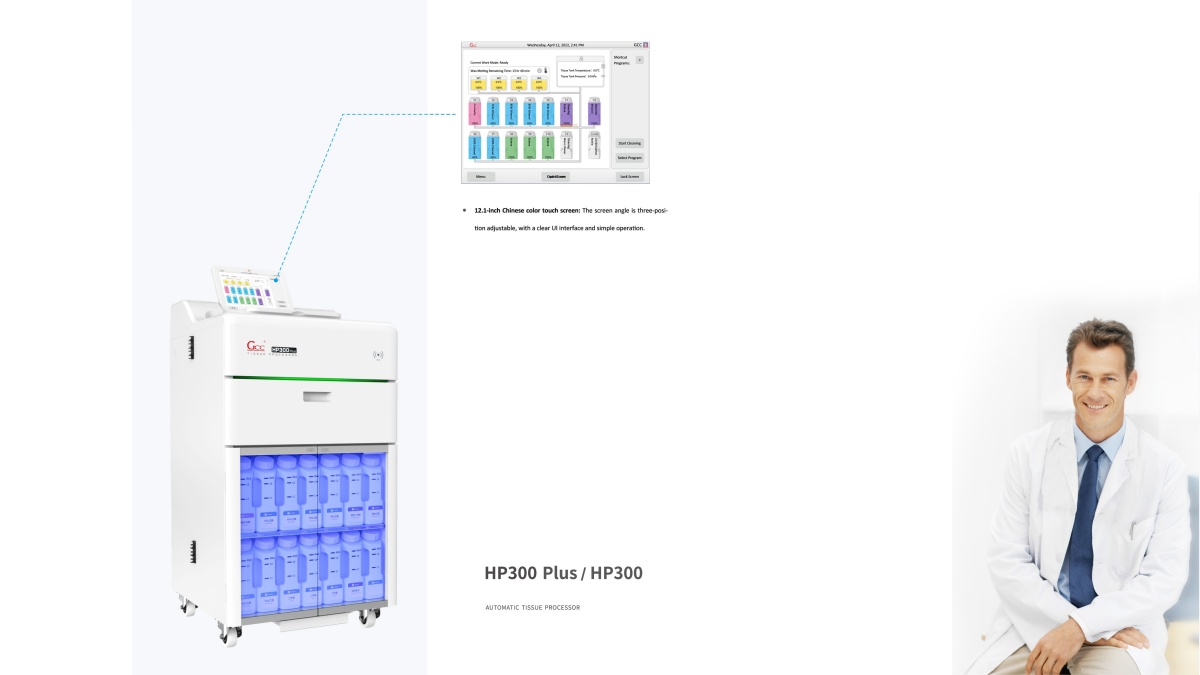
Tissue Processor GCC-T/ST/AI/BM450 / 380 / 220
Designed for Small to Medium-Sized Pathology Laboratories
This Tissue Processor configuration supports pathology laboratories with stable daily workloads and limited laboratory space. It offers processing capacities of 450, 380, or 220 tissue cassettes, allowing laboratories to select a model that matches their actual sample volume.
Its compact footprint allows easy integration into existing laboratory layouts. At the same time, the system delivers consistent performance across dehydration, clearing, and paraffin infiltration steps, supporting routine diagnostic workflows with reliable results.
From a workflow perspective, hospital pathology departments and research laboratories commonly use this configuration to balance processing quality with operational flexibility.
Tissue Processor GCC-T/ST/AI/BM900 / 660
Built for High-Throughput Pathology Centers
Laboratories with high sample volumes benefit from the GCC-T/ST/AI/BM900 / 660 Tissue Processor, which supports processing capacities of 900 or 660 tissue cassettes. This configuration addresses the needs of centralized pathology laboratories and regional diagnostic centers.
Compared to medium-capacity systems, this model enables continuous, large-batch tissue processing. As a result, hospital pathology departments and reference laboratories rely on it to manage peak workloads while maintaining consistent turnaround times.
In addition, the high-capacity design helps laboratories consolidate processing steps, reduce manual handling, and improve overall workflow efficiency.
Workflow Compatibility in Pathology Laboratories
Both Tissue Processor configurations integrate smoothly into standard histopathology workflows. They support automated dehydration, clearing, wax infiltration, and embedding preparation, ensuring consistent tissue handling before sectioning.
Laboratories can select processing capacity based on daily case volume, staffing patterns, and future expansion plans. This approach helps maintain stable and predictable tissue processing performance as laboratory demands evolve.
By aligning system capacity with real-world workflow requirements, pathology laboratories improve operational efficiency while preserving diagnostic consistency.
Conclusion
Different pathology laboratories require different tissue processing equipment capacities. Medium-volume laboratories often benefit from compact and flexible systems, while high-throughput pathology centers depend on robust configurations capable of handling large sample volumes.
Choosing the right Tissue Processor model represents both a technical and strategic decision. It directly influences workflow efficiency, sample consistency, and long-term laboratory performance.