坤灵最新logo-scaled-1.png)
The pathology laboratory is a core facility in hospitals for disease diagnosis and pathological research. Its working environment directly affects diagnostic accuracy, staff health and safety, and overall workflow efficiency. As one of the most fundamental and frequently used furniture systems in the laboratory, the design quality of workbenches is essential. This article provides a systematic overview of the design specifications for pathology laboratory workbenches to guide new construction and renovation projects.
I. General Design Principles
Pathology laboratory workbenches should follow these core principles:
- Safety:
Prioritize biosafety, chemical safety, electrical safety, and personnel protection. The design must comply with relevant safety standards and regulations. - Functionality:
Designed around key pathology workflows such as tissue processing, embedding, sectioning, staining, and immunohistochemistry. Layouts should be clear and logical to avoid cross-contamination. - Human-Centered Design:
Follow ergonomic principles to reduce operator fatigue and provide a comfortable and efficient working environment. - Durability and Easy Maintenance:
Materials should be corrosion-resistant, heat-resistant, easy to clean/disinfect, and structurally robust, with convenient maintenance and repair. - Flexibility:
Consider future technological developments and evolving needs. The design should allow for scalability and adaptability.
II. Workbench Categories and Dimensional Standards
Based on function, pathology laboratory workbenches can be categorized as:
1. Grossing Bench
Used for specimen examination and dissection. Commonly made of stainless steel, with a recessed sink for tissue handling, independent water supply/drainage, rinse systems, and waste disposal.
Typical dimensions:
- Length: ≥ 2.4 m
- Width: ≥ 0.9 m
- Height: ~0.85 m
2. Technical Workbenches
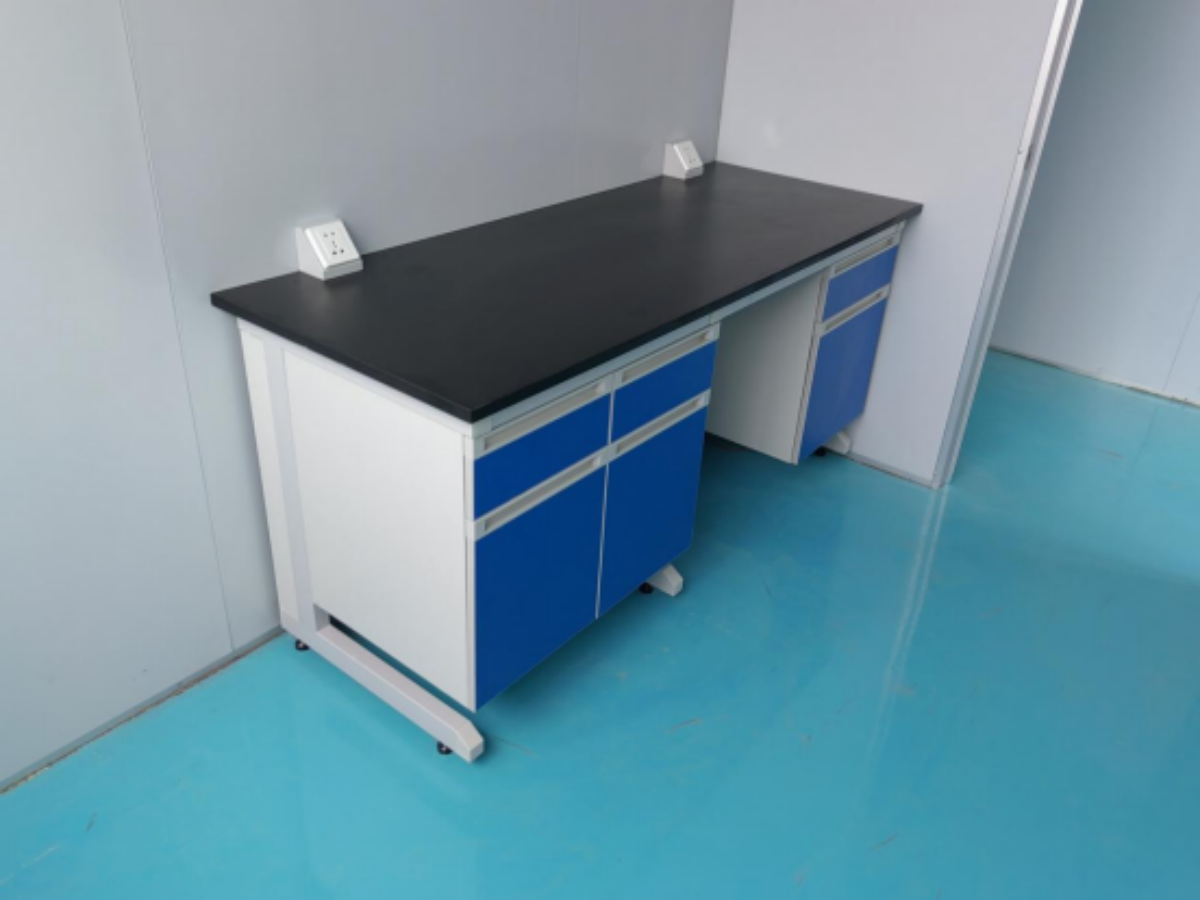
Used for embedding, sectioning, stretching, staining, and other precision tasks. The surface must be flat, stable, and vibration-resistant.
- Height: 850–900 mm, suitable for average adult height to reduce lower back fatigue. Some adjustable-height units may be included.
- Depth: Typically 750 mm, ensuring adequate workspace even with equipment placed on the bench.
- Length: Determined by room size and workstation quantity; each workstation should be at least 1.2 m wide.
3. Reagent Preparation/Storage Benches
Used for storing and preparing reagents, equipped with reagent racks, safety bottle holders, and ventilation as needed.
III. Worktop Material Specifications
Worktop materials directly affect safety and service life. Required properties include:
- Corrosion Resistance
Must withstand formalin, xylene, acids, alkalis, and other common reagents. - Heat Resistance
Must endure short-term contact with high-temperature items (embedding molds, soldering tools) without deformation. - Easy to Clean
Surface should be non-porous, non-absorbent, and suitable for frequent disinfection. - Durability
Capable of resisting daily abrasion and impact.
Recommended Materials:
a. Epoxy Resin Board – Best overall performance and the preferred choice for pathology labs; higher cost.
b. Phenolic Resin Board (Solid Core) – Good chemical resistance and cost-effective; heat resistance slightly lower than epoxy.
c. Stainless Steel – Ideal for grossing benches; easy to clean but prone to scratches and may react with certain chemicals.
d. Ceramic – Excellent heat and chemical resistance; brittle and difficult to seal at joints.
IV. Functional Zoning and Auxiliary Facilities
Workbenches should incorporate defined functional zones and integrated accessories:
- Storage
Under-bench cabinets and drawers for tools, glassware, and consumables. Drawers should have dividers for item categorization. - Reagent Shelves
Dual-layer shelves above the bench for frequently used reagent bottles. Should include anti-slip bars and be made of corrosion-resistant materials with ventilation openings. - Water and Electrical Systems
- Water Supply/Drainage:
Corrosion-resistant sinks (e.g., PP material) with suitable depth. Drain pipes must be sealed and chemically resistant. - Electrical System:
Adequate splash-proof multi-function sockets, logically distributed to avoid extension cords. Proper circuits should be planned based on equipment load. Lighting should be bright and shadow-free; LED fixtures with covers are recommended.
- Water Supply/Drainage:
- Safety Devices a. Emergency Shower and Eyewash
Required near reagent handling areas, easily accessible at all times. b. Ventilation
For operations involving volatile chemicals, integrate fume extraction arms or benchtop exhaust modules above or behind the bench. Grossing benches require dedicated high-efficiency exhaust systems.
V. Ergonomics and Layout Guidelines
- Workflow-Based Layout
Workbenches should align with the pathology workflow (grossing → dehydration → embedding → sectioning → staining → mounting), ensuring unidirectional flow and preventing clean-contaminated crossover. - Operating Space
Clearance between benches or between benches and central islands should be at least 1.5 m to allow smooth movement and emergency evacuation. - Detail Design
Rounded edges to prevent injury; streamlined cabinet handles for easy grip.
VI. Conclusion
Pathology laboratory workbenches are not simple furniture but integrated work units combining water, electricity, ventilation, safety systems, and task-specific functions. Their design must be based on a thorough understanding of pathology workflows and potential risks, strictly complying with relevant national and industry standards. A well-designed workbench system enhances diagnostic efficiency and quality while protecting laboratory personnel and supporting sustainable laboratory development.
During the planning stage, it is essential to gather input from pathologists and technicians and collaborate closely with professional designers and suppliers to create a safe, efficient, and comfortable modern pathology laboratory.