坤灵最新logo-scaled-1.png)
Introduction: Growing Demands in Modern Pathology Laboratories
Pathology laboratories play a crucial role in modern medical diagnostics, supporting disease detection, cancer diagnosis, and biomedical research. In modern histology workflows, the tissue processor is one of the most essential instruments used for preparing tissue specimens for microscopic examination.
Every day, laboratories must process large numbers of tissue specimens for histological examination. This growing demand places higher requirements on laboratory efficiency, automation, and equipment reliability.
One of the most critical instruments in the histology workflow is the tissue processor. Selecting the right system based on daily tissue processing volume helps laboratories maintain stable specimen preparation, improve workflow efficiency, and reduce diagnostic turnaround time.
Why Daily Tissue Processing Volume Matters
When selecting a tissue processor, laboratories must carefully evaluate their average number of specimens processed per day. The equipment capacity should match the laboratory’s workload to ensure efficient operation.
Workflow Efficiency
A properly sized tissue processor allows laboratories to process specimens smoothly without creating workflow bottlenecks. When processing capacity is too small, laboratories may experience delays that affect the entire pathology workflow.
Automated tissue processing systems enable consistent specimen preparation while reducing manual intervention, allowing laboratory staff to focus on diagnostic tasks.
Turnaround Time for Diagnosis
Diagnostic turnaround time is a key performance indicator in hospital pathology departments. High-capacity tissue processors help laboratories shorten specimen preparation cycles, allowing pathologists to receive slides earlier for microscopic analysis.
Efficient tissue processing is especially important for cancer diagnostics, where rapid and accurate results directly affect patient treatment decisions.
Specimen Management and Laboratory Organization
Proper equipment capacity also helps laboratories manage specimen flow more effectively. With the right processing system, laboratories can organize samples according to daily workload, reducing the risk of specimen backlog and improving operational stability.
Tissue Processor Requirements for Different Laboratory Types
Pathology laboratories vary greatly in size and diagnostic workload. Therefore, different laboratories require tissue processors with different processing capacities.
Small Pathology Laboratories
Small hospital laboratories or research laboratories usually process a relatively limited number of specimens each day. Compact tissue processors with moderate capacity are ideal for these environments.
Key characteristics include:
- Space-efficient equipment design
- Reliable automated processing
- Stable daily specimen handling
These systems support routine histology workflows without requiring large laboratory space.
Medium-Sized Hospital Laboratories
Medium-sized hospital pathology departments typically process hundreds of specimens per day. They require tissue processors that provide both efficiency and flexibility.
Equipment used in these laboratories must support:
- Higher specimen capacity
- Stable long-cycle operation
- Flexible processing protocols for different tissue types
Automated systems with programmable workflows are commonly used in these environments.
High-Throughput Pathology Centers
Large hospitals, diagnostic centers, and regional pathology laboratories often process hundreds to thousands of tissue samples daily. These facilities require high-capacity automated tissue processors capable of supporting continuous laboratory operation.
High-throughput equipment helps these laboratories maintain fast diagnostic turnaround times while ensuring consistent specimen quality.
Tissue Processor Model Selection
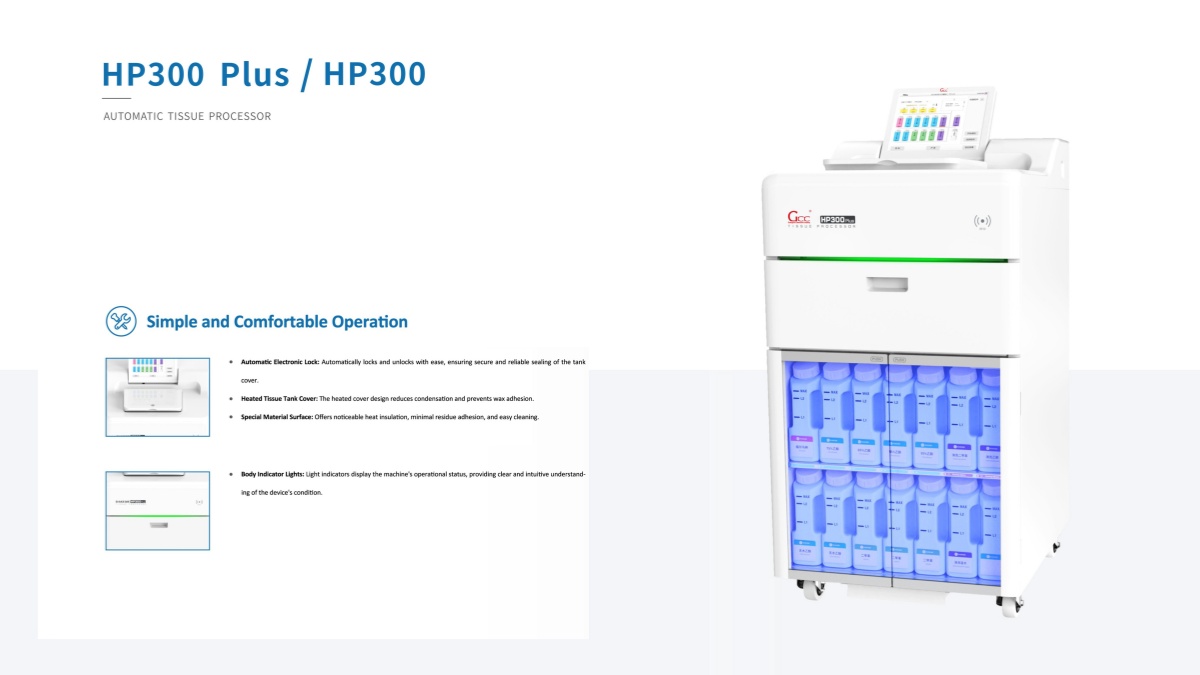
To meet the needs of different pathology laboratories, GCC pathology provides a range of automated tissue processor models designed for different processing capacities and laboratory scales.
Models for Small to Medium Laboratories
The GCC-T/ST/AI/BM450, BM380, and BM220 tissue processors are designed for routine pathology laboratories.
Key features include:
- Processing capacity of 450, 380, or 220 tissue cassettes
- Compact footprint suitable for laboratories with limited space
- Stable automated processing for daily specimen preparation
- Flexible configurations based on laboratory workload
These models are commonly used in hospital pathology departments and research laboratories performing routine histology work.
High-Capacity Models for Large Laboratories
For laboratories with higher specimen volumes, GCC pathology also provides the GCC-T/ST/AI/BM900 and BM660 tissue processors.
These systems support:
- Simultaneous processing of 900 or 660 tissue cassettes
- Continuous operation for high-volume diagnostic workflows
- Efficient specimen management for centralized pathology laboratories
These high-throughput systems are suitable for large hospitals, diagnostic centers, and regional pathology facilities.
Tissue Processor Core Technical Features
Modern tissue processors must provide reliable automated processing while maintaining laboratory safety and specimen integrity. GCC pathology tissue processors incorporate several advanced technical features designed for professional pathology applications.
Fully Enclosed Processing System
The fully enclosed processing chamber reduces reagent evaporation and limits exposure to chemical fumes in the laboratory environment. This design improves laboratory safety and helps maintain stable reagent conditions.
Precision Temperature Control
A constant temperature control system maintains an operating range of 30°C to 70°C, ensuring optimal conditions for tissue dehydration and paraffin infiltration.
Stable temperature control is essential for maintaining specimen quality during processing.
Programmable Intelligent Control System
The intelligent control interface allows laboratories to program customized processing workflows. Different tissue types require different processing protocols, and programmable systems help laboratories maintain consistent and repeatable results.
Tissue Processor Technical Specifications
Processing Capacity
| Model | Capacity |
|---|---|
| GCC-T/ST/AI/BM900 | 900 cassettes |
| GCC-T/ST/AI/BM660 | 660 cassettes |
| GCC-T/ST/AI/BM450 | 450 cassettes |
| GCC-T/ST/AI/BM380 | 380 cassettes |
| GCC-T/ST/AI/BM220 | 220 cassettes |
Reagent System
Reagent Bottles
- BM900 / BM660: 13 reagent bottles
- BM450 / BM380 / BM220: 11 reagent bottles
Paraffin Wax Bottles
- BM900 / BM660: 4 paraffin tanks
- BM450 / BM380 / BM220: 3 paraffin tanks
Additional Technical Parameters
| Parameter | Specification |
|---|---|
| Retort Capacity | 6 L |
| Power Consumption | 1.5 – 2.0 kW |
| Power Supply | 220V / 50Hz |
Frequently Asked Questions
How does a tissue processor work in histopathology?
A tissue processor automates the dehydration, clearing, and paraffin infiltration of tissue specimens. It moves samples through graded alcohols, xylene, and molten paraffin under controlled temperature and vacuum conditions. What is a Tissue Processor
Automatic vs manual tissue processor — which one is right for your lab?
Automatic tissue processors offer higher throughput, consistent results, and reduced technician involvement, making them ideal for busy labs. Manual processors may suit smaller facilities with lower specimen volumes. Automatic vs Manual Tissue Processors
How to choose a tissue processor based on daily processing volume?
Your daily specimen volume is the primary factor. Low-volume labs (under 50 samples/day) may use smaller benchtop models, while high-throughput labs (100+ samples/day) need larger capacity systems with multiple processing chambers. Tissue Processor Selection
What ventilation is required for tissue processors?
Tissue processors use xylene and other solvents that require proper ventilation. Fume extraction and room ventilation systems are essential to maintain safe air quality in histology laboratories. Tissue Processor Ventilation
What equipment is needed for a histology laboratory?
A complete histology lab requires grossing stations, tissue processors, embedding stations, microtomes, water baths, staining systems, coverslippers, microscopes, and fume hoods. Histology Lab Equipment List
Conclusion
As pathology laboratories continue to face increasing diagnostic workloads, selecting the right tissue processor based on daily tissue processing volume becomes essential for maintaining efficient laboratory workflows.
With flexible processing capacities ranging from 220 to 900 tissue cassettes, GCC pathology tissue processors provide reliable solutions for laboratories of different sizes—from routine hospital pathology departments to high-throughput regional diagnostic centers.
By combining automated processing technology, intelligent workflow control, and stable specimen preparation, these systems help laboratories improve efficiency and support accurate pathological diagnosis.