坤灵最新logo-scaled-1.png)
In large-scale public hospital projects, enterprise diagnostic networks, and laboratory infrastructure upgrades, equipment procurement must meet strict regulatory requirements. Among the most critical investments is the Pathology Grossing Station. These workstations handle hazardous chemicals such as formaldehyde every day. Therefore, buyers must evaluate more than operational features. They must also assess airflow performance, material compliance, and long-term facility integration.
For federal contractors, government suppliers, and EPC (Engineering, Procurement, and Construction) firms, selecting the right manufacturing partner can significantly improve project outcomes. Furthermore, compliance-ready equipment often strengthens tender submissions and simplifies project approvals.
This guide explains the key technical specifications, ventilation requirements, and international standards required for modern pathology laboratories.
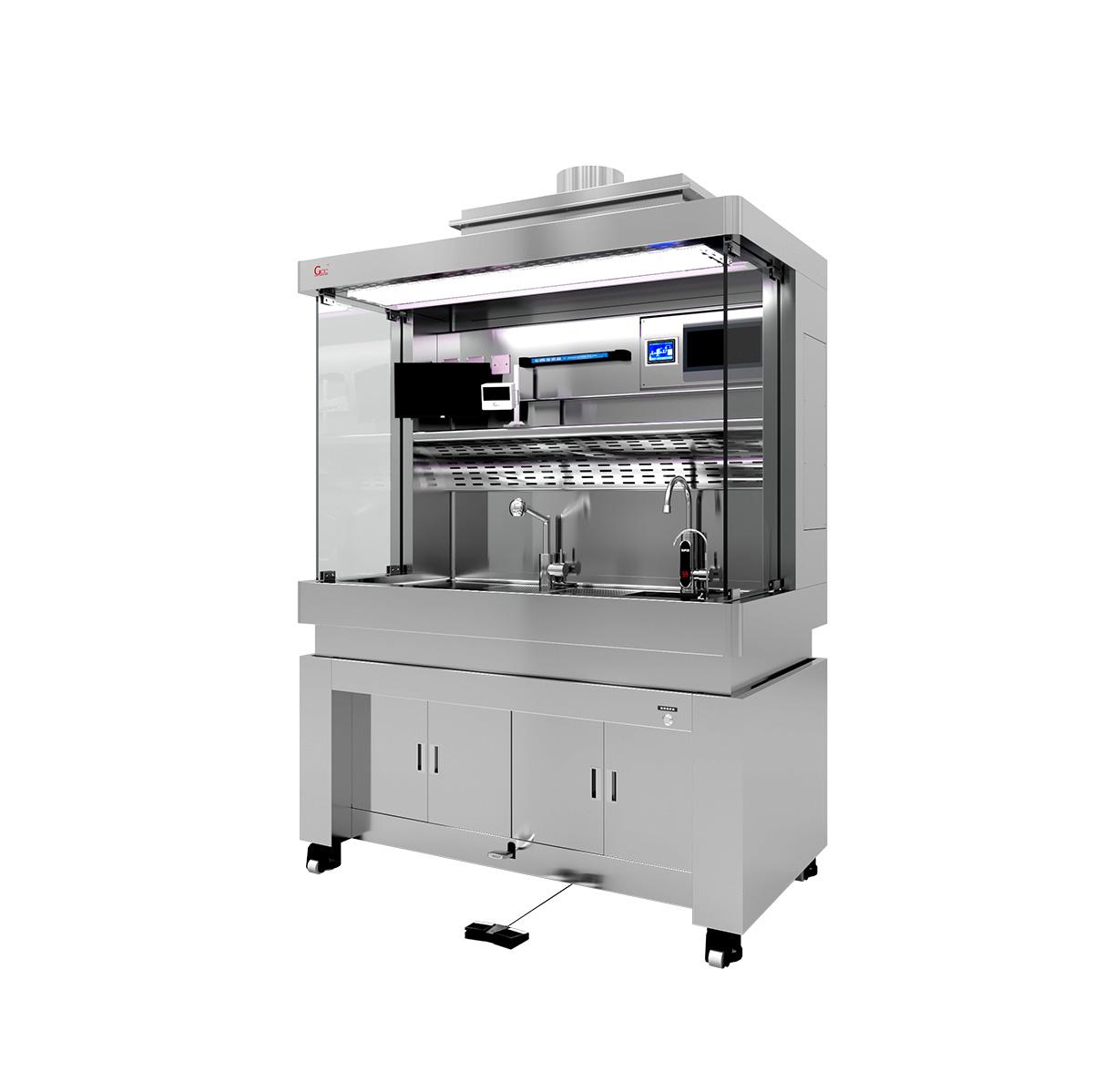
1. Ventilation Aerodynamics: Achieving Reliable Airborne Containment
The primary function of a Pathology Grossing Station is the containment of volatile organic compounds (VOCs). In high-volume laboratories, equipment must continuously capture hazardous vapors to protect personnel during extended work shifts.
Face Velocity Requirements
First, procurement teams should verify face velocity performance rather than relying on general airflow ratings. A high-quality grossing station should maintain a consistent face velocity of 0.40–0.50 m/s (80–100 fpm) across the entire work surface. This helps ensure effective vapor capture during routine specimen processing.
Dual-Plenum Extraction Design
In addition, modern pathology laboratories benefit from a combined downdraft and backdraft extraction system.
Because formaldehyde vapors are heavier than air, downdraft airflow draws contaminants downward into the extraction plenum. Meanwhile, rear backdraft slots capture cross-currents generated by operator movement. As a result, chemical vapors remain outside the technician’s breathing zone.
HVAC and BMS Integration
For new laboratory construction and facility modernization projects, grossing stations should include external exhaust connections, typically ranging from 150 mm to 200 mm in diameter.
Consequently, the workstation can integrate directly with the facility’s HVAC and Building Management System (BMS). This allows air-handling units to balance pressure gradients effectively and maintain stable negative pressure within the laboratory environment.
2. Metallurgical Integrity: Engineering for Long-Term Service Life
Beyond ventilation performance, material selection directly affects equipment durability, compliance, and total cost of ownership.
Public healthcare facilities often evaluate equipment over a service life of 15 to 20 years. Therefore, corrosion resistance and structural integrity are essential procurement criteria.
316 Stainless Steel Construction
Many entry-level laboratory workstations use 304 stainless steel. However, this material may degrade under frequent exposure to chlorine-based disinfectants and pathology chemicals.
For this reason, premium pathology grossing stations should be manufactured from heavy-gauge 316 stainless steel. The molybdenum content in 316 stainless steel provides enhanced resistance to chloride-induced corrosion, pitting, and crevice attack. As a result, the workstation maintains its performance and appearance for many years.
Radius-Coved Internal Corners
Furthermore, internal basins, splashbacks, and ventilation chambers should feature seamless radius-coved corners.
Unlike sharp 90-degree joints, curved surfaces reduce contamination traps and simplify cleaning procedures. Consequently, laboratories can achieve faster sanitization and improved compliance with quality standards such as ISO 15189, CAP, and NABL requirements.
3. Ergonomic Design for Modern Pathology Workflows
Today’s pathology laboratories operate across multiple shifts and support a wide range of users. Therefore, workstation ergonomics have become an important purchasing consideration.
Motorized Height Adjustment
Modern grossing stations should include motorized height-adjustable systems. Typically, adjustment ranges extend from 800 mm to 1100 mm.
This flexibility allows both seated and standing operation. In addition, it helps reduce repetitive strain injuries and operator fatigue. As a result, laboratories can improve comfort and productivity throughout the working day.
Digital Pathology Integration
Meanwhile, digital pathology continues to transform specimen documentation and workflow management.
To support these processes, grossing stations should provide integrated mounting solutions for digital imaging cameras, barcode scanners, touch-screen displays, and foot-pedal dictation systems. Furthermore, splash-resistant LAN and USB connectivity improves reliability in demanding laboratory environments.
4. Engineering Documentation: The Key to Successful Project Delivery
For EPC contractors and healthcare construction teams, equipment procurement involves much more than product selection. It also requires accurate engineering coordination.
Unfortunately, procurement delays often occur when suppliers cannot provide detailed technical documentation. Therefore, project teams should prioritize manufacturers capable of delivering complete engineering support.
BIM, Revit, and CAD Documentation
A qualified manufacturing partner should supply BIM, Revit, and CAD drawings during the design stage.
These documents should clearly identify all mechanical, electrical, and plumbing (MEP) requirements, including:
- Water supply connections
- Drainage locations
- Electrical loads
- Exhaust duct dimensions
- Service access points
As a result, architects, engineers, and contractors can coordinate installations more efficiently and reduce costly site modifications.
Compliance Validation
In addition, suppliers should provide airflow validation reports and containment performance data.
This documentation helps demonstrate compliance with project specifications and simplifies equipment commissioning. Furthermore, verified performance data can accelerate approval processes during regulatory inspections.
The GCC Advantage: Turnkey Engineering for Institutional Laboratory Projects
GCC is a global manufacturer specializing in pathology laboratory infrastructure and high-containment cleanroom systems. We support EPC contractors, government procurement teams, healthcare institutions, and laboratory developers worldwide.
More importantly, we provide complete project support rather than supplying equipment alone. Our engineering teams assist clients with design consultation, technical submittals, CAD layouts, and customized manufacturing solutions.
From heavy-duty laboratory benches and chemical fume hoods to advanced pathology grossing stations, GCC delivers systems designed for demanding clinical environments and long-term operational reliability.
Request Technical Support for Your Next Project
Are you preparing a public hospital tender, laboratory modernization project, or institutional healthcare facility upgrade?
Contact GCC’s international project team to obtain:
- Technical datasheets
- CAD and layout drawings
- Compliance documentation
- Competitive project quotations
- Preliminary laboratory planning support
Explore Our Product Portfolio: www.gccpathology.com
Project RFQ & Engineering Support: Victor@gccpathology.com
WhatsApp: +86 18148635992