坤灵最新logo-scaled-1.png)
Ten Years of Experience Behind a Grossing Station That Truly Understands Your Work
In the core working areas of pathology departments and anatomy laboratories, technicians use the grossing station more than any other piece of equipment. Even a minor design flaw can interrupt workflow efficiency, while an unsuitable material choice can create long-term cleaning and hygiene risks.
Why do more professional institutions choose our grossing stations?
The answer lies behind the phrase “years of experience serving pathology and anatomy laboratories.” Over time, we transformed hands-on project experience into practical solutions by deeply understanding real working scenarios.
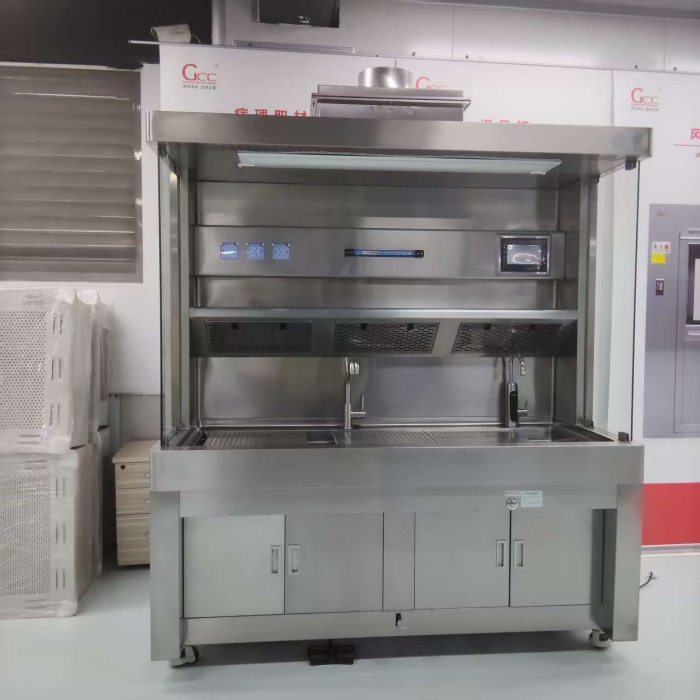
1. Pain Points as the Starting Point: We Understand Your Unspoken Needs
Pathology and anatomy laboratories operate in highly specialized environments with clear, demanding requirements:
- High-efficiency drainage: Tissue residues easily cause blockages, and traditional drainage systems take time to clean
- Corrosion resistance: Formalin, xylene, and other reagents aggressively attack work surfaces
- Safety awareness gaps: Aerosol exposure and sharps injuries often receive insufficient attention
- Inefficient space use: Poor instrument organization and unclear workflows slow daily operations
- Ergonomic strain: Long hours of standing during grossing increase occupational fatigue
Our team conducted on-site investigations and analyzed service feedback from hundreds of laboratories. We categorized these pain points and developed targeted design improvements. Every operational inconvenience now directly guides our product upgrades.
2. Experience Turned into Advantage: Design Details That Define Professionalism
1) Three-Stage Filtration Drainage System
Using ten years of project data, our engineers developed a three-stage system combining coarse filtration, fine filtration, and liquid-solid separation.
The first stage intercepts large tissue fragments, the second captures fine debris, and the third completes separation. This design reduces blockage rates by 92% and shortens cleaning time by 70%.
2) Comprehensive Corrosion-Resistant Material Matrix
Our long-term material testing program tracks how different reagents affect surface materials. Based on these results, we developed a composite ceramic and specialized resin work surface. Tests confirm that it withstands over 5,000 hours of continuous exposure to common pathology reagents without discoloration or deformation.
3) Aerodynamic Safety Protection Design
Our design team analyzed airflow behavior in anatomy laboratories and created a surrounding negative-pressure capture system. This system forms a directional airflow barrier around the working zone and actively draws harmful aerosols into the filtration unit, significantly reducing operator exposure.
4) Modular Functional Zoning
We designed the work surface according to standardized pathology grossing workflows and divided it into four zones:
initial examination, grossing, temporary storage, and cleaning.
This layout shortens movement paths, reduces unnecessary motion, and improves overall working efficiency.
3. Proven in Practice: How Experience Solves Real Problems
Case 1: Pathology Department Upgrade at a Tertiary Hospital
The previous grossing station caused drainage blockages two to three times per month, and each cleaning took up to one hour.
After the department installed our grossing station, it recorded zero blockages over 18 months, and technician satisfaction increased significantly.
Case 2: New Medical School Anatomy Laboratory
The laboratory needed a solution that supported both teaching demonstrations and routine grossing work.
We integrated extendable auxiliary work surfaces and multi-angle camera systems to create an environment that allows one operator to work while multiple students observe, without disrupting daily procedures.
4. Continuous Evolution: Experience Drives Improvement
We do not treat experience as a final achievement. Instead, we use it as a foundation for continuous refinement:
- We collect feedback from laboratories across different regions and disciplines
- We update a “common issues and improvements” database every quarter
- We introduce at least two design enhancements each year based on real usage scenarios
- We actively participate in drafting three regional standards for pathology laboratory equipment
5. Choosing Us Means Choosing Understanding
When you choose our grossing station, you gain more than a piece of equipment. You gain:
- A solution aligned with real pathology workflows
- Professional control over safety requirements in anatomy laboratories
- Long-term ergonomic protection for operators
- A design that prioritizes easy cleaning and maintenance
Because we understand how you work, we know how to deliver lasting value.