坤灵最新logo-scaled-1.png)
1. Introduction: Special Requirements for Pathology Department Environmental Control
Unlike ordinary comfort HVAC systems, pathology department ventilation systems prioritize safety as the primary objective. Their core requirements include:
- Hazardous substance control: Volatile organic compounds (VOCs) such as formaldehyde and xylene are known carcinogens and must be effectively controlled and removed at the source.
- Biosafety protection: Biological aerosols generated during operations must be strictly confined within contamination zones to prevent spread.
- Environmental stability: Precise experiments, such as immunohistochemistry and molecular pathology, require highly stable temperature, humidity, and cleanliness; microscope diagnostics require a vibration-free, undisturbed airflow environment.
- Process compliance: The system must support “three-zone division” (contaminated, semi-contaminated, and clean areas) and unidirectional flows for people, materials, and air, in accordance with standards such as CNAS-CL02.
Therefore, the HVAC system acts as the “respiratory and immune system” of the pathology department, ensuring safe, accurate, and efficient operation.
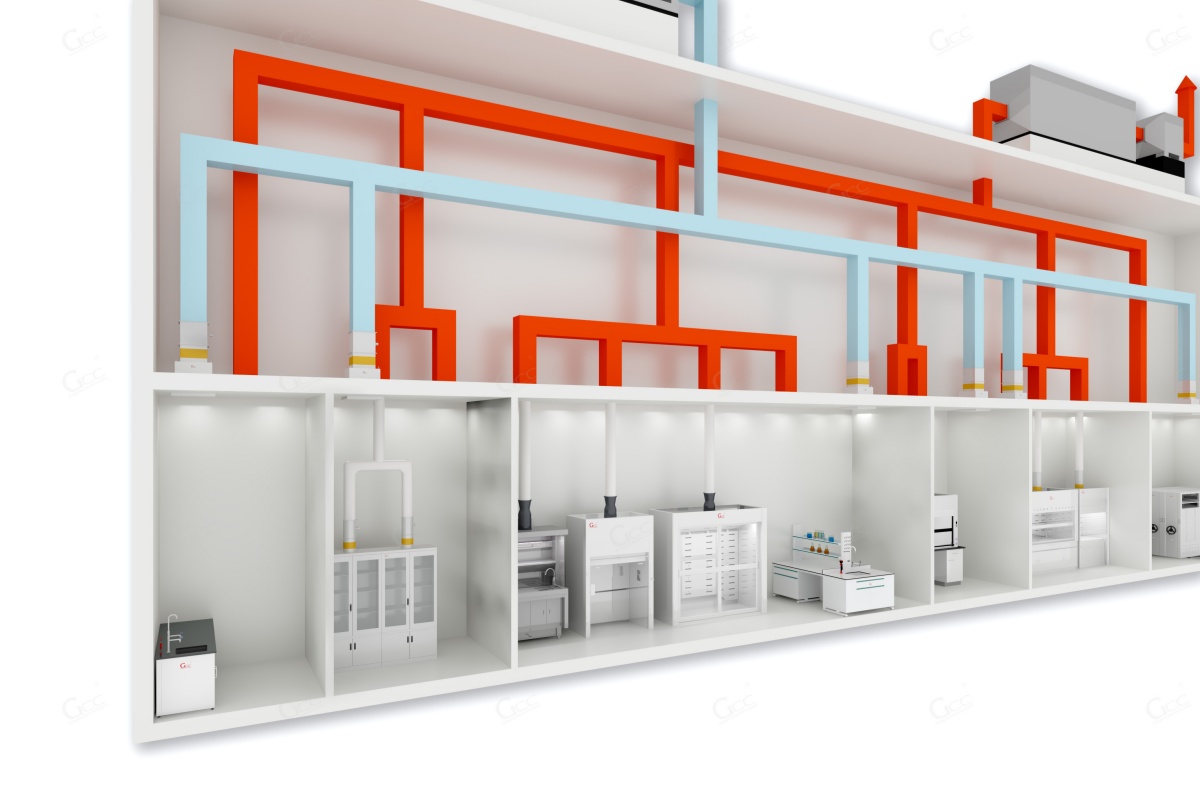
2. Zonal Environmental Control Strategy and Design Parameters
Each functional zone in a pathology department has distinct environmental requirements. Independent control and demand-based distribution are essential.
| Functional Zone | Core Requirements | Pressure Control | Air Changes per Hour (ACH) | Air Handling Strategy | Temperature & Humidity |
|---|---|---|---|---|---|
| Grossing Room | Source control of hazardous gases, highest biosafety | Full negative pressure (≥ -5 Pa) | ≥ 12 | 100% fresh air, exhaust treated before release | 22 ±2°C, 50 ±10% |
| Technical/Processing Room | Control solvent vapors such as xylene | Negative pressure | ≥ 10 | High fresh air, mixed return air allowed (after treatment) | 22 ±2°C, 50 ±10% |
| Immunohistochemistry/Molecular Pathology | Cleanliness, precise temperature/humidity | Positive pressure (≥ +5 Pa) | ≥ 10 | HEPA filtration, precise temp/humidity control | 22 ±1°C, 50 ±5% |
| Pathology Diagnosis Room | Quiet, stable, airflow-free, protect staff | Positive pressure | 6–8 | Recirculated air with medium filtration, low-speed supply | 24 ±2°C, 50 ±10% |
| Sample Storage/Archive | Mold, fire prevention, constant temperature & humidity | Slight positive pressure | 4–6 | Dedicated HVAC unit, corrosion-resistant | 20 ±2°C, 40 ±5% |
3. Key Subsystems and Technical Analysis
3.1 Pressure Gradient Control System: The “Rudder” of Airflow
Principle:
By precisely controlling supply and exhaust airflow in each room, a stable pressure gradient is established: Clean Area (Diagnosis Room) → Semi-contaminated Area (Technical Room) → Contaminated Area (Grossing Room). This ensures unidirectional airflow and prevents contaminant spread.
Implementation:
- Variable Air Volume (VAV) System: VAV dampers are installed on supply and exhaust ducts. Room pressure sensors provide real-time feedback, adjusting airflow dynamically to maintain stable pressure. This is currently the most advanced and energy-efficient control method.
- Constant Air Volume (CAV) System: Mechanical dampers manually set airflow. Simple but less resistant to disturbances (e.g., door openings can cause pressure imbalance).
3.2 Hazardous Gas Treatment System: The “Final Line of Defense”
- Grossing Table Exhaust: Must have a dedicated exhaust system. Centralized wet scrubbers neutralize formaldehyde and other gases efficiently at relatively low operating cost.
- Technical Room Exhaust: Fume hoods and staining machines producing xylene-laden air require high-efficiency activated carbon adsorption units (dry system). Activated carbon must be regularly monitored and replaced.
- Emission Standards: All treated exhaust must meet regulatory standards such as the Integrated Emission Standard of Air Pollutants (GB16297) before being discharged.
3.3 Precision Environmental Control System: The “Guardian of Quality”
- Temperature & Humidity Control: Secondary return air or reheat technology maintains precise conditions while ensuring sufficient fresh air changes. This prevents overcooling or excessive humidity.
- Cleanliness Control: For molecular pathology areas (e.g., PCR labs), unidirectional airflow must follow reagent preparation → sample processing → amplification analysis. Full fresh-air AHUs combined with HEPA supply diffusers achieve ISO Class 10,000–100,000 cleanliness standards.
4. Intelligent Management and Energy-Saving Innovations
- Integrated Smart Control System:
The system integrates VAV controls for grossing tables and fume hoods, room pressure monitoring, and AHUs. It enables device interlocking, fault alarms, data logging, and traceability, greatly improving management efficiency and system reliability. - Heat Recovery Technologies:
In cold climates, rotary or plate-fin heat recovery devices reclaim energy from exhaust air to precondition fresh air. This reduces AHU load and saves 20–40% of energy. - Night/Weekend Reduced Mode:
The smart system reduces ventilation and temperature/humidity control precision in unoccupied areas while maintaining safety baselines (e.g., slight negative pressure), significantly lowering energy consumption.
Frequently Asked Questions
How to minimize formaldehyde exposure in pathology labs?
Minimize formaldehyde exposure through proper ventilation, formalin filling systems, down-draft exhaust on grossing stations, personal protective equipment, and regular air quality monitoring. Formaldehyde Exposure Guide
What ISO and quality standards apply to pathology laboratories?
Pathology labs typically comply with ISO 15189 (medical laboratories), CAP (College of American Pathologists) requirements, and GMP standards for quality management and operational consistency. Pathology Lab Quality Control
What biosafety level is required for a pathology lab?
Most clinical pathology labs operate at BSL-2 level, requiring biosafety cabinets for specimen handling, proper waste management, and adherence to standard precautions for infection control. Lab Safety Standards
What is the difference between ducted and ductless fume hoods?
Ducted fume hoods exhaust contaminated air outside the building through ductwork, ideal for high-volume chemical use. Ductless fume hoods use HEPA and activated carbon filtration to clean and recirculate air, offering flexible installation. Pathology Fume Hood Guide
What are the key standards for pathology laboratory design?
Pathology lab design must comply with ISO 15189, CAP, and local biosafety regulations. Key considerations include workflow zoning, pressure differentials, airflow management, and equipment layout. Pathology Lab Design Standards
5. Conclusion and Recommendations
A modern pathology department HVAC system must follow these principles:
- Safety First: Ensure stable pressure gradients and effective hazardous gas removal.
- Demand-Based Distribution: Tailor environmental control strategies according to zone function.
- Intelligent & Reliable: Use automated control for precise, stable, and traceable operations.
- Green & Sustainable: Employ heat recovery, VAV, and other technologies to reduce lifecycle costs while meeting safety and process needs.
Recommendation:
During early project planning, HVAC engineers should collaborate closely with the pathology director and lab managers to translate operational requirements into accurate design parameters. This ensures a safe, healthy, efficient, and future-ready pathology work environment.