坤灵最新logo-scaled-1.png)
Tissue Processor Technical Specifications for Pathology Laboratories
In pathology laboratories, technical specifications play a decisive role in equipment selection. Beyond automation claims or general performance descriptions, procurement teams and laboratory managers focus on measurable parameters that directly affect workflow capacity, processing stability, and long-term operational reliability.For this reason, clearly defined Tissue Processor technical specifications are essential for hospitals, diagnostic centers, and centralized pathology laboratories evaluating pathology-grade systems.
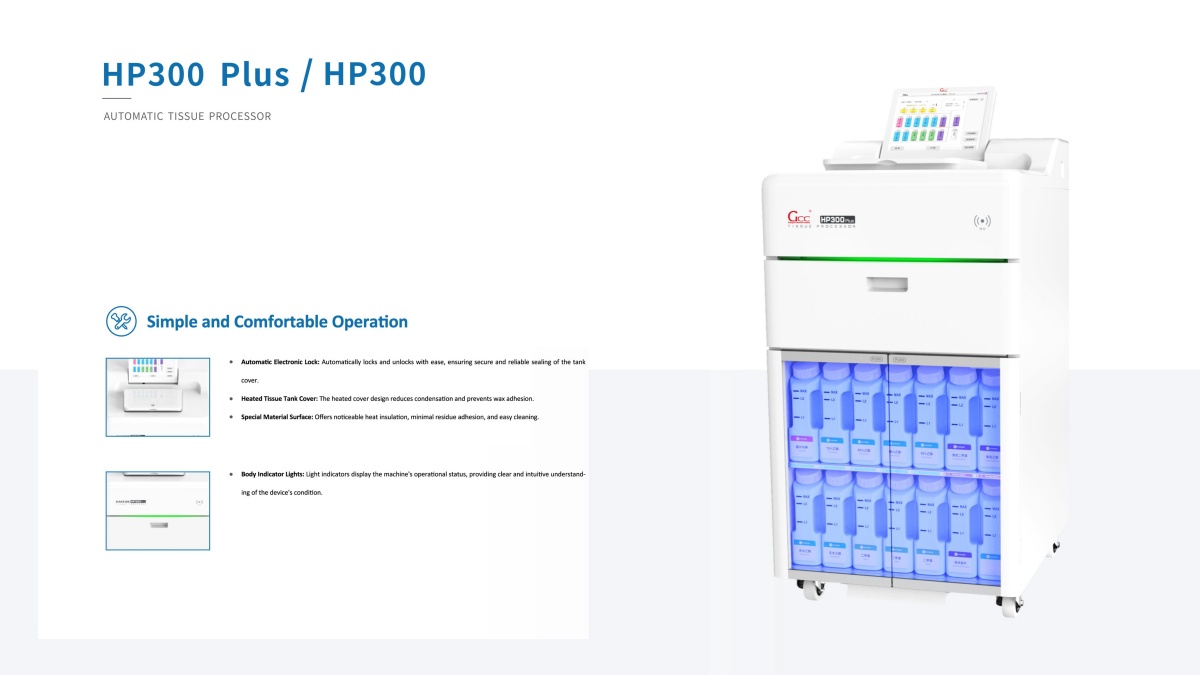
Tissue Processor Technical Specifications Overview
The following specifications outline key performance indicators commonly reviewed during pathology equipment procurement. These parameters support both routine diagnostic workflows and high-throughput histopathology operations.
High-Capacity Tissue Processor Models
The GCC-T/ST/AI/BM900 / 660 Tissue Processor is designed for laboratories with large daily sample volumes.
It supports processing capacities of:
- 900 tissue cassettes
- 660 tissue cassettes
As a result, this configuration is suitable for hospital pathology departments, regional diagnostic centers, and centralized laboratories managing continuous high-throughput workloads.
Medium-Capacity Tissue Processor Models
For laboratories with moderate or variable case volumes, the GCC-T/ST/AI/BM450 / 380 / 220 configuration offers flexible capacity options:
- 450 tissue cassettes
- 380 tissue cassettes
- 220 tissue cassettes
Therefore, laboratories can align processing capacity with actual daily demand, avoiding unnecessary overcapacity while maintaining stable turnaround times.
Reagent System Configuration for Histopathology Workflows
Multi-Reagent Bottle Design
In addition to processing capacity, reagent system configuration directly influences workflow flexibility and processing consistency.
- 900 / 660 models: equipped with 13 reagent bottles
- 450 / 380 / 220 models: equipped with 11 reagent bottles
This multi-reagent layout allows laboratories to configure complex dehydration and clearing sequences according to tissue type, fixation method, and diagnostic protocol.
Paraffin Wax Bottle Capacity
Paraffin infiltration represents a critical stage in tissue processing. Accordingly, wax bottle capacity is designed to match throughput requirements:
- 900 / 660 models: 4 paraffin wax bottles
- 450 / 380 / 220 models: 3 paraffin wax bottles
Consequently, laboratories can support extended processing cycles without frequent intervention, which improves operational continuity and reduces manual handling.
Reaction Chamber Capacity and System Performance
Reaction Chamber Volume
All configurations feature a reaction chamber capacity of 6 liters, providing sufficient volume for uniform reagent circulation and consistent tissue exposure.
This chamber size supports stable processing conditions across both small and large batch runs, contributing to reproducible histological outcomes.
Power and Electrical Requirements
From an infrastructure perspective, the Tissue Processor is designed for compatibility with standard laboratory utilities:
- Power consumption: 1.5–2.0 kW
- Power supply: 220V / 50Hz
As a result, laboratories can integrate the system without extensive electrical modifications, simplifying installation and commissioning.
Why These Technical Specifications Matter in Procurement Decisions
In summary, Tissue Processor procurement decisions rely on objective technical parameters rather than general automation claims. Processing capacity, reagent configuration, chamber volume, and power requirements collectively determine whether a system can support real-world pathology workflows.
By selecting configurations aligned with daily case volume and laboratory infrastructure, pathology laboratories achieve predictable performance, operational stability, and long-term scalability.
Ultimately, clearly defined technical specifications ensure that the Tissue Processor functions as reliable pathology infrastructure rather than a generic laboratory instrument.