坤灵最新logo-scaled-1.png)
Grossing station ventilation is one of the most important factors in controlling formalin exposure in pathology laboratories. A properly designed ventilation system protects operators, improves laboratory safety, and ensures compliance with occupational health standards.
Formaldehyde is the most common occupational chemical hazard in histopathology. The International Agency for Research on Cancer (IARC) classifies it as a Group 1 carcinogen, confirmed to cause cancer in humans. The US National Institute for Occupational Safety and Health (NIOSH) recommends an exposure limit of 0.016 ppm (ceiling value).
During standard pathology grossing procedures involving formalin-fixed specimens, ambient formaldehyde concentrations in poorly ventilated stations can reach 0.5–2.0 ppm, which is 30–125 times higher than recommended limits.
The grossing station is the highest exposure point in a pathology laboratory. Its ventilation design determines whether operators remain within safe exposure limits or accumulate long-term hazardous exposure. This guide explains why conventional systems fail and what modern compliant systems must include.
Why Outdated Grossing Stations Fail at Formalin Control
Most grossing stations installed before 2015 use a single rear-exhaust design, where air is extracted from a horizontal grille at the back of the worktop and connected to building exhaust systems.
While suitable for lower-volume workflows, this design has three major limitations in modern laboratories:
Problem 1: Vapors are captured only after reaching the operator’s breathing zone
Formalin vapors rise directly from specimen containers toward the operator’s breathing zone. Rear exhaust systems pull air horizontally backward, meaning vapors pass through the operator’s breathing zone before capture occurs. The system controls contamination too late in the airflow path.
Problem 2: No directed clean air supply to protect the breathing zone
Rear exhaust systems only create negative pressure, pulling uncontrolled room air into the workstation. This incoming air is not filtered or directed, and does not actively protect the operator from formaldehyde exposure.
Problem 3: Airflow performance fluctuates with building exhaust load
When multiple laboratory systems share a central exhaust, pressure variations reduce airflow stability. A system rated at 0.4 m/s may drop to 0.2 m/s during peak load conditions, significantly reducing capture efficiency.
These are structural design limitations, not maintenance issues.
Downdraft vs Rear Exhaust: Which Design Works Better?
Rear Exhaust System
Air flows horizontally from front to rear. Vapors must travel across the operator’s breathing zone before being captured.
Downdraft (Negative Pressure) System
Air is pulled downward directly at the work surface, capturing vapors at the source before they rise.
GCC-QCT System Specifications:
- Exhaust airflow: 1,500–2,000 m³/h
- Face velocity: ≥0.8 m/s
- 3-speed touchscreen control
- Air–water separation system (prevents condensation buildup in ductwork)
Key Comparison:
| Feature | Rear Exhaust | GCC Downdraft |
| Capture point | Rear of bench | At specimen source |
| Face velocity | 0.3–0.5 m/s | ≥0.8 m/s |
| Dependence on building system | High | Low |
| Protection efficiency | Weak | Strong |
What a Modern Grossing Station Must Include
1. Negative pressure downdraft exhaust system
Key requirements:
- ≥1,500 m³/h airflow
- ≥0.8 m/s face velocity at work surface
- Independent fan system
- Air–water separation structure
2. Laminar fresh air supply system
Provides clean air into the operator breathing zone, forming a top-supply, bottom-exhaust airflow pattern.
- Fresh air volume ≥600 m³/h
- Perforated laminar diffuser panel
- Non-recirculated air supply
3. Real-time environmental monitoring system
Continuously measures:
- Formaldehyde concentration (ppm)
- PM2.5
- TVOC
- Air pressure
- Airflow velocity
- Airflow volume
This supports ISO 15189 and CAP compliance documentation.
4. UV sterilization system
- UV intensity ≥1,300 mW/m²
- Timer-controlled operation
- Full work surface coverage
Ducted vs Ductless Systems
Ducted Exhaust System
Air is discharged outside the building through dedicated ductwork.
Advantages:
- Permanent removal of formalin from building
- Preferred for hospitals and high-volume labs
Requirements:
- Dedicated exhaust duct
- Adequate airflow capacity (1,500–2,000 m³/h)
- Compliance with local discharge regulations
Ductless (Recirculating) System
Uses activated carbon filters to capture formaldehyde and recirculates air.
Advantages:
- No duct installation required
Limitations:
- Filter replacement every 3–6 months
- Lower airflow capacity
| Feature | Ducted | Ductless |
| Air removal | External discharge | Internal filtration |
| Operating cost | Low | High (filters) |
| Best for | Hospitals/universities | Small clinics |
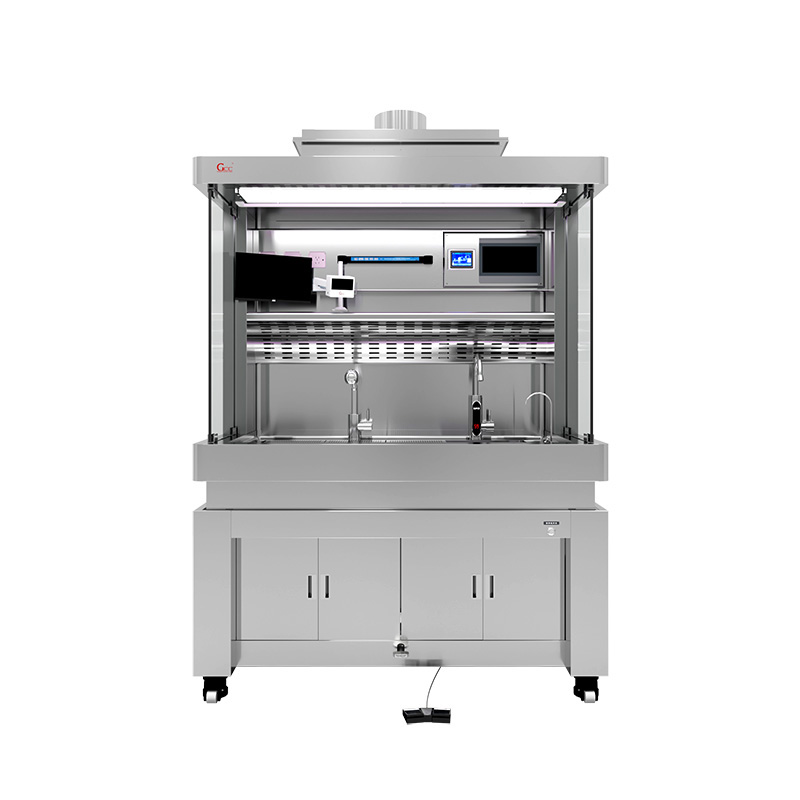
GCC Smart Grossing Station Series
Standard models:
- G11: 1100 mm
- G15: 1500 mm
- G18: 1800 mm
- G20: 2000 mm
- G22: 2200 mm
Full Technical Specifications:
- Exhaust system: negative pressure downdraft + air–water separation
- Airflow: 1,500–2,000 m³/h
- Face velocity: ≥0.8 m/s
- Fresh air supply: ≥600 m³/h
- Material: SUS304 stainless steel
- UV intensity: ≥1,300 mW/m²
- Monitoring: formaldehyde / PM2.5 / TVOC / airflow / pressure
- Installation: ducted system (installation not included)
Required Specifications Before Purchase
Before issuing a purchase order, request:
- Exhaust airflow (m³/h)
- Face velocity at work surface (m/s)
- Fresh air supply system availability
- UV irradiance (mW/m²)
- Real-time formaldehyde monitoring
- Ducted vs ductless configuration
- Installation scope details
GCC provides pathology grossing solutions to hospitals, universities, and research laboratories worldwide.
For technical documentation, specifications, or pricing:
�� Victor@gccpathology.com
�� WhatsApp: +86 181 4863 5992