坤灵最新logo-scaled-1.png)
In modern Pathology Lab Layout design, air quality control inside the grossing room is critical. Laboratory ventilation directly affects staff safety, regulatory compliance, and daily workflow efficiency.
During tissue gross examination and trimming procedures, pathology specimens release volatile organic compounds (VOCs) such as formaldehyde and xylene. Without proper ventilation, these chemical vapors can accumulate rapidly inside the laboratory.
For hospitals and pathology laboratories, ventilation performance is no longer just an equipment issue. It is now a core requirement for NABL, ISO 15189, CAP, and hospital accreditation standards.
As a professional Pathology Laboratory Equipment supplier, GCC frequently works with hospitals, laboratory contractors, and overseas distributors facing two major engineering questions:
- Should the laboratory use a ducted or ductless grossing station?
- How should downdraft and backdraft airflow systems be balanced?
This guide explains the key engineering principles behind a compliant and efficient pathology ventilation system.
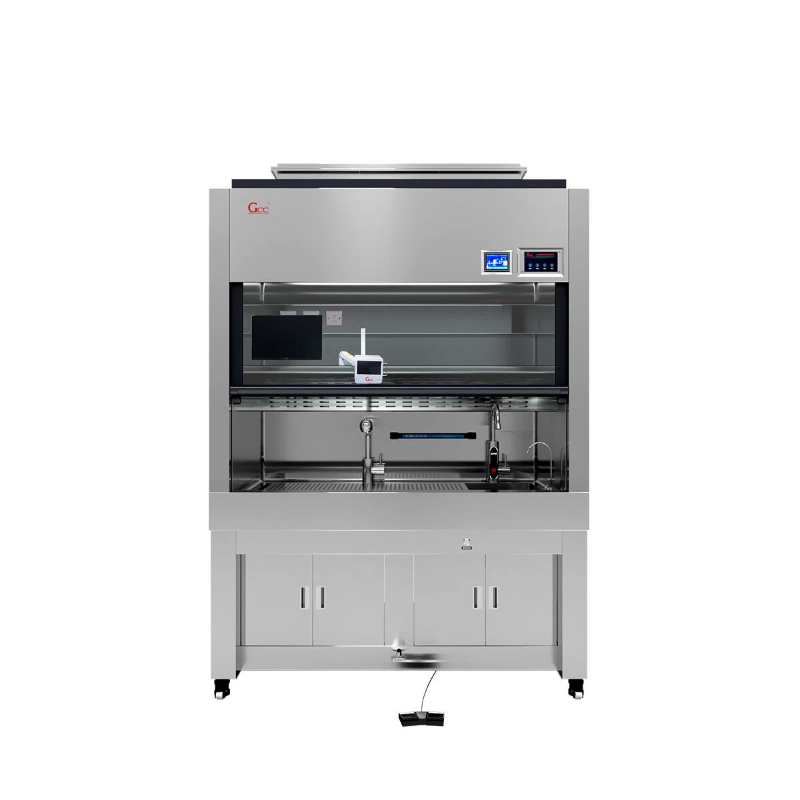
1. Ducted vs. Ductless Grossing Stations
When planning a Pathology Laboratory Design, engineers must first determine how hazardous fumes will be handled inside the facility.
A. Ducted Grossing Stations
A ducted grossing station removes hazardous fumes completely from the building through external ductwork and exhaust fans.
The system normally uses corrosion-resistant PVC or polypropylene ducts connected to a roof-mounted centrifugal blower.
Best Applications
- New hospital construction projects
- Dedicated pathology laboratory buildings
- Large medical centers with mechanical ventilation shafts
- High-volume histopathology laboratories
Main Advantages
- No air recirculation inside the laboratory
- Stable performance during continuous formaldehyde exposure
- Lower long-term maintenance costs
- No frequent activated carbon replacement
- Better suitability for large pathology departments
Engineering Considerations
Duct routing and static pressure calculations are extremely important in ducted systems. Improper duct sizing can reduce airflow efficiency and create uneven vapor extraction.
B. Ductless Grossing Stations
Ductless grossing stations operate without external ductwork. The workstation contains integrated blowers and multi-stage chemical filtration systems.
Most ductless systems use:
- Activated carbon filtration
- Potassium permanganate media
- HEPA filtration
These filters remove formaldehyde vapors, xylene fumes, and airborne particles before clean air returns to the room.
Best Applications
- Renovation projects
- Older medical facilities
- Leased laboratory buildings
- Locations with restricted duct installation
- Small forensic laboratories
Main Advantages
- Fast installation
- No external duct construction
- Flexible laboratory placement
- Lower initial construction requirements
- Easy relocation in future laboratory upgrades
Installation Benefits
Most ductless grossing stations only require:
- Electrical connection
- Water supply and drainage
- Equipment positioning
This greatly shortens laboratory construction time.
2. Downdraft vs. Backdraft Airflow Systems
A professional Grossing Station for Histopathology should always include both downdraft and backdraft extraction systems.
This dual-extraction design improves operator protection and increases chemical capture efficiency.
A. Downdraft Airflow System
The downdraft system captures heavy chemical vapors near the work surface.
Formaldehyde vapor is denser than normal air. The downdraft design pulls contaminated air downward through a perforated stainless steel work surface before the vapor reaches the operator’s breathing zone.
Main Benefits
- Reduces direct chemical exposure
- Improves operator comfort
- Prevents upward vapor spread
- Enhances workstation containment performance
B. Backdraft Airflow System
The backdraft system captures chemical fumes generated during specimen pouring, slicing, and formalin handling procedures.
Air is pulled horizontally through rear extraction grills positioned behind the working area.
Main Benefits
- Captures localized vapor release
- Controls turbulent airflow
- Improves airflow stability
- Enhances overall extraction efficiency
3. Airflow Balancing in Ducted Systems
Airflow balancing is one of the most important engineering factors in pathology ventilation systems.
Poor airflow balancing can create:
- Uneven extraction
- Excessive airflow noise
- Dead airflow zones
- Reduced fume containment performance
GCC engineering teams carefully calculate duct resistance and airflow distribution to maintain stable extraction performance.
Recommended Face Velocity
Professional pathology grossing stations should maintain an average face velocity between:
- 0.40 m/s to 0.50 m/s
Low airflow velocity may fail to capture hazardous vapors effectively.
Excessively high airflow velocity can:
- Increase noise levels
- Dry tissue specimens
- Disturb operator handling procedures
Optimized Duct Design
GCC uses 45-degree duct junctions instead of restrictive 90-degree connections whenever possible.
This design helps:
- Reduce airflow resistance
- Lower static pressure loss
- Improve airflow smoothness
- Increase extraction efficiency
Integrated Balancing Dampers
Precision balancing dampers are installed inside the duct system to fine-tune airflow distribution.
In most pathology laboratory projects, GCC recommends:
- 60% downdraft airflow
- 40% backdraft airflow
This configuration provides stable airflow control for most histopathology applications.
4. Complete Pathology Laboratory Ventilation Integration
A modern pathology laboratory requires more than a standalone grossing station.
The entire laboratory ventilation system must work together as one integrated environment.
This normally includes:
- Grossing stations
- Pathology fume hoods
- Chemical storage cabinets
- Laboratory benches
- Room exhaust systems
- Make-up air systems
Variable Frequency Drive (VFD) Control
In centralized exhaust systems, GCC integrates Variable Frequency Drive (VFD) controls to stabilize room pressure.
As laboratory equipment turns on or off during the day, the exhaust fan automatically adjusts its speed.
This helps maintain:
- Stable negative pressure
- Consistent airflow
- Lower energy consumption
- Improved operator safety
Make-Up Air (MUA) Design
Large pathology ventilation systems remove substantial air volume from the laboratory.
Without sufficient make-up air, the room can develop excessive negative pressure.
This may cause:
- Heavy door operation
- Airflow instability
- Temperature imbalance
- Reduced ventilation efficiency
GCC calculates make-up air volume during the Pathology Lab Layout stage to maintain proper room pressure and operator comfort.
Why Hospitals Choose GCC
GCC provides complete pathology laboratory ventilation solutions for hospitals, laboratories, and medical distributors worldwide.
Our Services Include
- Pathology laboratory planning
- CAD and 3D layout design
- Grossing station manufacturing
- Ventilation engineering
- Ductwork design
- Plumbing coordination
- Overseas project support
Chemical-Resistant Construction
GCC systems use:
- 316 stainless steel
- Corrosion-resistant polymers
- Chemical-resistant ventilation components
These materials provide long-term resistance against formaldehyde, xylene, and acidic laboratory environments.
Compliance-Focused Engineering
Our ventilation systems are designed to support:
- ISO 15189 laboratories
- NABL compliance
- Hospital accreditation projects
- Occupational safety standards
Configure Your Pathology Ventilation System
If you are planning a new pathology laboratory or upgrading an existing histopathology facility, GCC can help you develop a safe and compliant ventilation solution.
Our engineering team can provide:
- Equipment recommendations
- Preliminary laboratory layouts
- Ventilation calculations
- Duct routing proposals
- Technical datasheets
Explore our pathology equipment solutions at:
GCC Pathology
For technical consultation, contact:
Victor@gccpathology.com
WhatsApp:
+86 18148635992