坤灵最新logo-scaled-1.png)
Tissue embedding is one of the most technically demanding steps in the histopathology workflow. If operators embed specimens poorly — with incorrect orientation, insufficient paraffin infiltration, or improper cooling rates — the resulting blocks section badly, produce microscopic artefacts, and often force laboratories to repeat the entire case.
In high-volume pathology departments, repeat embedding does not just slow down workflow. It delays diagnosis, increases reagent waste, and consumes additional operator time for every affected case.
The embedding machine you choose directly determines how consistently your lab performs this step across operators, shifts, and specimen types. This guide explains the three main equipment types, the specifications that matter most, how to match machines to lab workload, and what to confirm before issuing a purchase order.
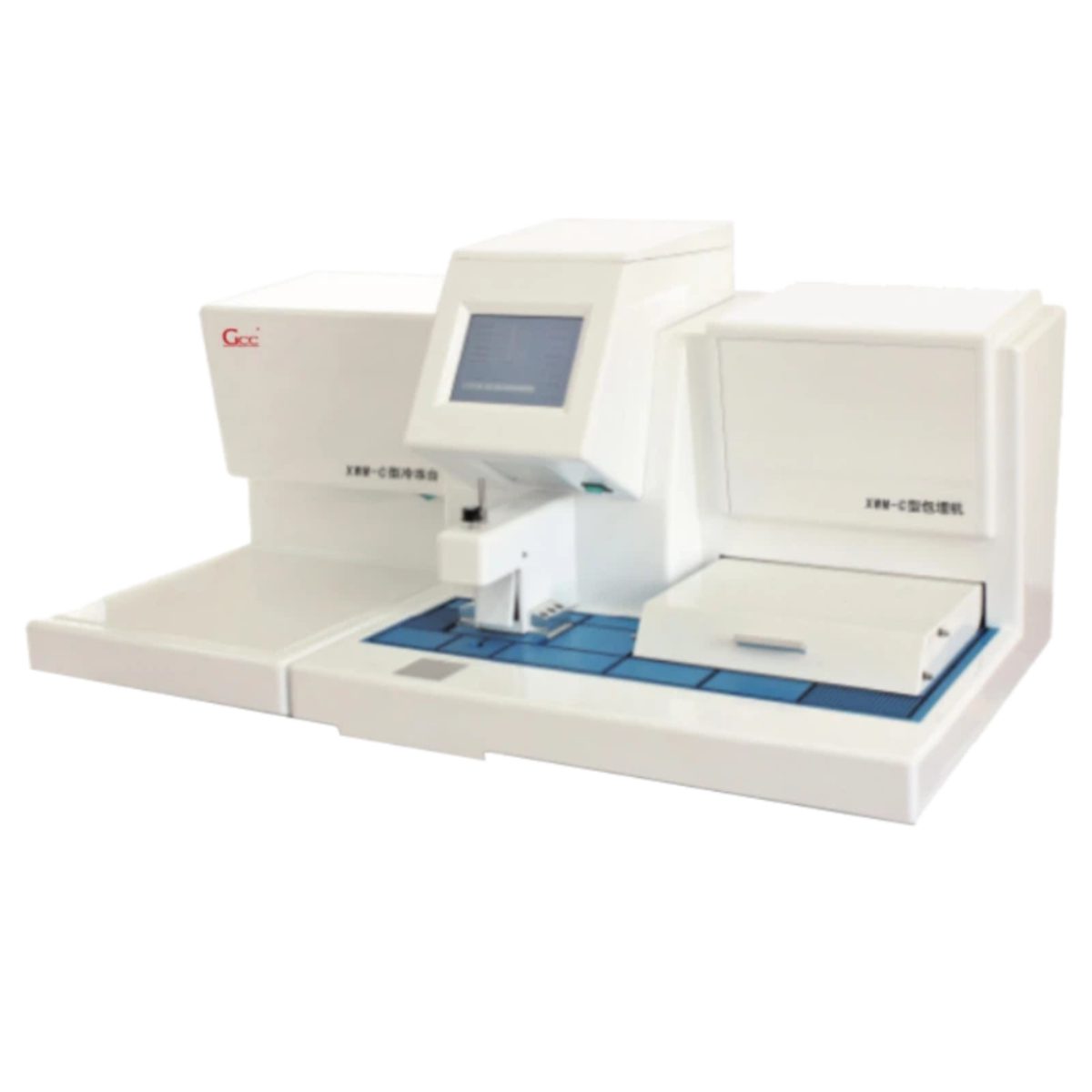
What a Tissue Embedding Machine Does
Before comparing equipment, you need to understand what the system must achieve. Different machine types accomplish these tasks with different levels of automation.
Tissue embedding requires three controlled steps:
- Paraffin dispensing
The machine dispenses molten paraffin (typically 58–65°C) into a metal mold at a controlled flow rate. - Tissue orientation
The operator opens the processed cassette and positions the specimen in the correct anatomical orientation before the wax solidifies. - Controlled cooling
The system transfers the mold to a cold plate (typically −5°C to −15°C), where paraffin solidifies quickly to form a stable block.
Every embedding machine performs these three steps. However, machines differ in how they automate each step, how precisely they control temperature, and how many specimens they handle at once.
Types of Tissue Embedding Machines
Manual Embedding Centres
Manual systems combine a heated wax dispenser with a separate cold plate. The operator controls every step, including wax dispensing, tissue orientation, mold handling, and cooling.
Best suited for:
Small private pathology labs, veterinary labs, teaching institutions, and low-volume workflows under 50 cassettes per day.
Limitations:
Operator variation affects consistency. Throughput remains slow. Long sessions increase fatigue and raise the risk of orientation errors.
Typical price range: $2,500–$6,000
Automatic Embedding Station
Automatic embedding stations integrate a heated wax dispenser, insulated cassette chamber, programmable controls, and a dedicated cooling plate into a single system.
Operators still perform tissue orientation, but the machine controls temperature stability, wax flow consistency, and cooling performance.
Key automated features include:
- Programmable start/stop cycles for overnight operation
- Wax recycling system that filters and reuses unused paraffin
- Dual overheating protection to prevent wax degradation
- Two-stage paraffin filtration to avoid debris blockage
- Large insulated cassette chamber to maintain specimen temperature
For example, the GCCM-C supports up to 222 cassettes in a 6.25L insulated chamber, keeping all specimens within optimal working temperature throughout the session.
Best suited for:
Hospital pathology departments, clinical diagnostic labs, and university laboratories handling 50–300 cassettes per day.
Typical price range: $8,000–$22,000
Fully Integrated Tissue Processor with Embedding Function
Integrated systems combine tissue processing (dehydration, clearing, paraffin infiltration) and embedding into one enclosed platform. The lab loads fixed tissue samples, and the system outputs finished paraffin blocks.
Advantages:
- Eliminates transfer between instruments
- Reduces contamination risk
- Saves laboratory floor space
- Simplifies workflow in compact facilities
Limitations:
- Higher capital investment
- Shared downtime affects both processing and embedding
- Less flexibility for labs with separate scheduling needs
Best suited for:
Small labs with space constraints or advanced labs building integrated histology workflows.
Typical price range: $35,000–$80,000
Key Specifications to Evaluate
When comparing machines in the same category, focus on the following specifications. Always request them in writing before purchase.
Temperature Control Precision
Paraffin must remain within a narrow temperature range throughout embedding. If temperature rises too high, wax degrades and tissues shrink. If it drops too low, viscosity increases and blocks develop voids.
Specify:
±1°C or better temperature control across wax reservoir, dispenser, and cassette chamber. Always request steady-state performance data, not startup values.
Cold Plate Temperature and Cooling Speed
Cooling speed directly affects block quality. Slow cooling causes crystallization artefacts. Uneven cooling creates inconsistent block hardness.
Specify:
- Cold plate range: −5°C to −15°C
- Prefer semiconductor (Peltier) cooling for uniform surface temperature
- Confirm time required to reach working temperature from ambient
Cassette Holding Capacity
The insulated chamber must support a full embedding session without repeated reloading.
Recommendation:
High-volume labs should target at least 150–250 cassette capacity.
Example:
GCCM-C supports up to 222 cassettes in a 6.25L insulated chamber.
Paraffin Filtration System
Tissue debris and degraded wax accumulate over time and can block dispensers or contaminate blocks.
Specify:
- Two-stage filtration minimum (coarse + fine filter)
- Clear filter replacement schedule
- Defined consumable cost
Wax Dispenser Adjustability
Different tissue types require different paraffin volumes. Fixed systems waste wax on small biopsies and underfill large molds.
Specify:
- Fine-adjustable flow control
- Stable low-volume dispensing capability
- Optional visual aid for precision filling
Embedding Machine Selection by Lab Type
| Lab Type | Daily Volume | Recommended Type | Key Priority |
|---|---|---|---|
| Small private lab / clinic | < 50 | Manual system | Cooling uniformity |
| District hospital | 50–150 | Automatic station | Capacity, wax efficiency |
| Teaching hospital | 100–250 | Large automatic system | Control + filtration |
| Reference lab | 250+ | Automatic / integrated | Throughput + uptime |
| Research / biotech | Variable | Automatic / integrated | Flexibility |
| Veterinary lab | 20–80 | Manual / compact auto | Size + cleaning ease |
Embedding Machine Price Guide
| Type | Capacity | Price Range | Notes |
|---|---|---|---|
| Manual embedding centre | — | $2,500–$6,000 | Operator-dependent |
| Compact automatic | 80–120 | $6,000–$12,000 | Entry hospital level |
| Standard automatic | 150–222 | $12,000–$22,000 | Hospital standard |
| Large automatic | 250+ | $20,000–$35,000 | High-volume labs |
| Integrated system | — | $35,000–$80,000 | All-in-one workflow |
For Southeast Asia and Middle East buyers, total landed cost usually increases by 15–25% due to freight, duties, and installation.
Common Purchasing Mistakes
1. Selecting capacity based only on current workload
Many labs grow quickly. If your lab expands within 2–3 years, undersized machines become a bottleneck and require costly replacement.
2. Ignoring cassette chamber temperature
Wax reservoir temperature alone does not guarantee quality. If cassette temperature drops too early, orientation becomes difficult and block quality suffers.
3. Overlooking wax recycling efficiency
Wax recycling can reduce paraffin consumption by 20–35% annually, but many buyers ignore it during procurement.
4. Not checking local service support
If maintenance requires overseas engineers, downtime increases significantly. Always confirm local service capability.
5. Ignoring mold compatibility
Embedding molds vary between manufacturers. Always confirm compatibility with your existing mold system before purchase.
GCC Pathology Embedding Station Range
GCC Pathology supplies the GCCM-C Automatic Embedding Station, designed for hospitals, universities, research institutions, and diagnostic laboratories.
Key Specifications
| Parameter | Specification |
|---|---|
| Cassette capacity | Up to 222 (6.25L chamber) |
| Temperature control | Programmable system |
| Wax recycling | Gravity reflux system |
| Safety protection | Dual thermal cutoff |
| Filtration | Two-stage system |
| Cooling system | Peltier semiconductor plate |
| Flow control | Adjustable dispenser knob |
| Accessories | Wax remover tool, integrated worktable |
| Applications | Hospital, research, pharma, veterinary, forensic |
The GCCM-C supports standalone embedding workflows. GCC Pathology also provides integrated tissue processor-embedding systems for laboratories building end-to-end histology workflows.
Request Technical Information
If you are selecting a tissue embedding machine for a new pathology lab, upgrading existing equipment, or preparing a procurement tender, you should request full technical documentation before purchase.
→ Request GCCM-C specifications and pricing
→ Speak with a histopathology equipment specialist
Contact: Victor@gccpathology.com
WhatsApp: +86 181 4863 5992